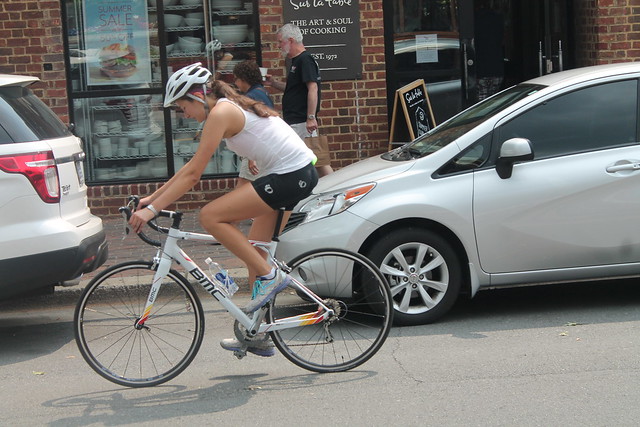
20.KingStreetTrolley.OldTownAlexandria.VA.9August2014
Earlier this summer, the City of Alexandria, Virginia urged commuters to ‘Rethink your Commute’ during SafeTrack 3 & 4 in Alexandria. Ridership on Metrorail plunged 70%+ during this time frame. Instead of taking Metrorail, I now rideshare (carpool) with friends. Other friends I know have started biking to work after SafeTrack.

So we wanted to know, have you changed your commute to and from work after SafeTrack?

Poll is OPEN through Sunday, August 21. Let us know in the comments below, how did your commute change in Alexandria (or if it is the same)?

VOTE in the sidebar on the right side of your screen.

(Flickr Pool photo via Elvert Barnes, on Flickr)

Living in the DMV as I do, I certainly worry about things like paying bills on time, ever increasing tax rates and getting to work on time but, I don’t know if I would call it high stress. Movato Real Estate looked at various stress categories like crime, commute time, high cost of living, and percentage of income spent on rent to name a few and Washington, DC came out on top as the most stressful city in America.

Here’s what they said as to why:

Our nation’s capital is home to countless politicians and their staff who, all jokes and jeers aside, actually do have pretty stressful jobs when you really think about it. However, the city is also home to countless normal people just going about their normal-profile lives, working at normal jobs, and, as it turns out, being exposed to supernormal levels of stress.

For all the cracks about politicians never really working, it turns out that the more than 601,000 people who call D.C. home are putting in plenty of hours on the job. The city came in third for this category, with residents working an average of 40.1 hours a week. That’s not even the top-end, but the average.

Commute time was another big factor in D.C.’s placement at the top of this ranking. At 33 minutes on average, it was ranked ninth overall. As for the rest of the stats, they spanned from 35th to 11th, but were all consistently high enough for the city’s average score to put it on top as America’s stress capital.

Do you think it’s very stressful living here in the Washington, D.C. area? If so, why?

Washington DC typically ranks as one of the worst commutes in the USA. Imagine what it would be like without the 1956 Federal Highway Act passed during the Eisenhower years.

We have added a link to a great search tool for apartments in the Carlyle/Eisenhower East area called Walk Score Apartment Search. You can search for apartments by commute time.

Whether you prefer driving, public transit, walking, or biking, Walk Score can help you find a commute that fits your lifestyle. See the video above on how the system works. You can find the link under the ‘Carlyle/Eisenhower East’ tab, then mouse over ‘Live in Carlyle’, then click ‘Apartments in Carlyle/Eisenhower East’.

If you commute into D.C. by car, this post is for you…

Commuters who travel the 14th Street Bridge need to prepare for a new traffic configuration on Monday morning, August 23 (See graphic).

As with Phases 2 and 3, during Phase 4 of the project, concrete barriers creating an “island of construction.” Lanes will be split and traffic will be routed on both sides of the construction barriers – 3 lanes to the right and 1 lane to the left.

While crews prepare for this phase, only 3 lanes of the bridge will be available from Friday at 10 p.m. until Monday at 5 a.m. Traffic will return to four lanes by Monday at 5 a.m.

More from DDOT:

Motorists continuing onto the 14th Street Bridge from northbound I-395 are advised that the left exit lane (Exit 10C) to the Memorial Bridge can also be used as a through lane. Motorists are not required to exit and can continue straight onto the 14th Street Bridge.

Key Impacts

  • Shorter Merging Distances: With a center lane of the bridge under construction, motorists will have a shorter distance (approximately 1/8 mile) to change lanes to get to their exits.
  • 3 lanes will be routed to the right and 1 lane will be routed to the left of barrier blocks on the southern half of the bridge. This will affect:
    • Motorists entering from northbound GW Parkway and moving left to exit onto 14th Street.
    • Motorists continuing to northbound I-395 from the left lanes of the bridge.

Drivers are advised to keep left if exiting onto 14th Street and keep right if continuing on I-395N.

Real Time Analytics