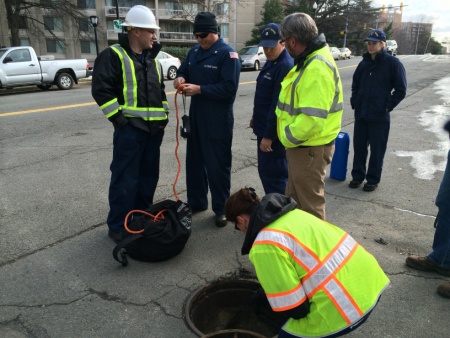
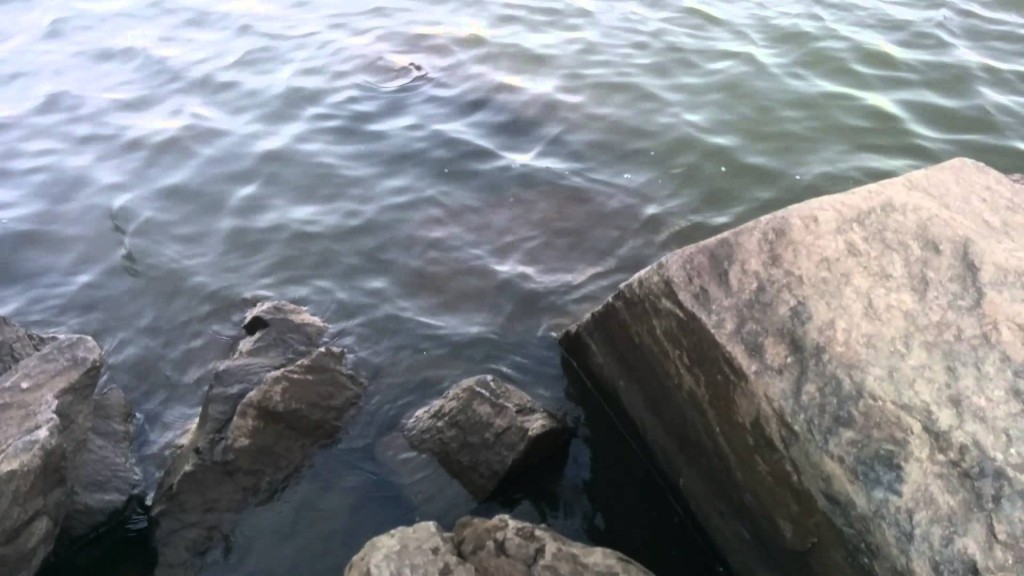
Potomac River @ Gravelly Point in Arlington, Virginia

Unified Command concludes response to Potomac River oil sheen

The Unified Command announced Friday it has concluded the emergency response phase of the oil response at Roaches Run Waterfowl Sanctuary near Arlington, Virginia, and is transitioning into a remediation project led by Virginia Department of Environmental Quality.
The Coast Guard and the Department of Energy and Environment will remain available for support but will not have an active role in the remediation phase.

After more than two weeks of response operations, no additional sheening has been observed, and no additional impacted wildlife has been reported.

In total, eight miles of shoreline were impacted, and there were 29 wildlife fatalities.

Tri-State Bird Rescue and Research is scheduled to release the first 20 rehabilitated birds back into the wild at Belle Haven Park at noon Monday.

Government agencies involved included:

  • DC Department of Energy and Environment
  • Virginia Department of Environmental Quality
  • Virginia Department of Game and Inland Fisheries
  • U.S. Coast Guard Sector Baltimore
  • U.S. Coast Guard Atlantic Strike Team
  • National Pollution Funds Center
  • U.S. Department of the Interior
  • U.S. Fish & Wildlife Service
  • U.S. Park Service
  • U.S. Department of Agriculture
  • U.S. Animal and Plant Health Inspection Service
  • National Oceanic and Aeronautic Administration
  • Environmental Protection Agency
  • Arlington County Fire Department
  • Arlington County Public Works
  • Metropolitan Washington Airport Administration
  • Maryland Department of Environment
  • Tri-State Bird Rescue & Research
  • Dominion Virginia Power

“This has been a true team effort across and within all of our agencies, and I want to express my heartfelt thanks to everyone who supported this response,” said Lt. David Ruhlig, operations section chief. “Our efforts spanned five jurisdictions and at least 16 governmental agencies, each within their own concerns and specializations. Our common focus on protecting public safety and the environment was the driving force behind this response.”

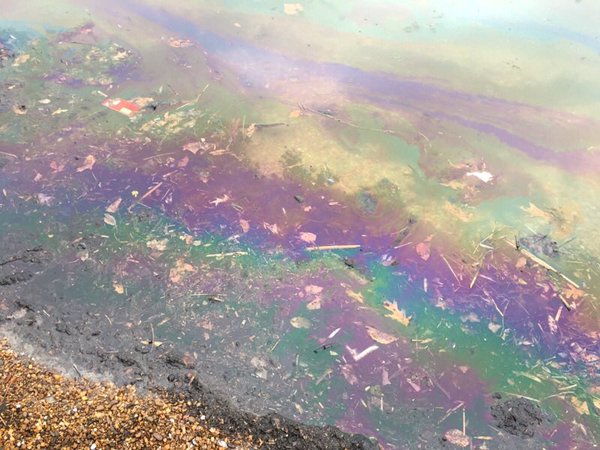
Potomac River Oil Spill (Photo via @PotomacRiver on Twitter)
Delegate Mark Levine (D-45), in a ‘Richmond Report’ email, noted the following on the recent Potomac River oil spill that we were able to bring to you first. We were also the first to raise awareness on the possible Dominion Power connection.

I have been saying for over a week that Dominion Power was most likely responsible for the recent oil spill in the Potomac, and now they have finally admitted it. Dominion must now fully pay for the costs of the cleanup. But more importantly, we need to keep environmental damage like this from happening again. We need better containment structures when transformers fail and more public notice. Lowell Feld of Blue Virginia raises some good tough questions. Why did it take 10 days and the personal efforts of Delegate Mark Levine for the initial 13,500-gallon oil-spill to be made public? Is there any doubt this whole thing would have been covered up if eight miles of oil had not been released into the Potomac?

You can subscribe to Mark’s Richmond Report online.

(Photo via @PotomacRiver on Twitter)

Coast Guard photo - Potomac River Oil Sheen

Unified Command continues response to Potomac River oil sheen

The Unified Command continues its response to oil sheens Tuesday in the Potomac River near Arlington, Virginia.

The Unified Command plans to use a deterring technique Tuesday to keep birds from entering Roaches Run Waterfowl Sanctuary.

“The use of small pyrotechnics to deter birds from using particular areas during an oil response is a commonly employed technique utilized by wildlife biologists to minimize the negative impacts of oil to birds and other wildlife,” said Peter McGowan, a wildlife biologist with Fish and Wildlife Services.

This technique is scheduled to continue through Friday to allow time for the remaining sheen to dissipate.

This is the same technique regularly used at Ronald Reagan Washington National Airport to ward off birds.

“The sheen in the pond is light but still remains, and we want to minimize any potential for additional birds from being oiled.” said Cmdr. Michael Keane, the incident commander.

Tri-State Bird Rescue & Research is continuing to rehabilitate impacted birds at their facility in Delaware.

Fish and Wildlife Services, and Animal and Plant Health Inspection Service personnel will remain on scene to assist in the capture and recovery of any further impacted wildlife.

US Coast Guard responds to Potomac River Oil Spill (Courtesy photo)

UNIFIED COMMAND RECEIVES FIRST OIL SAMPLE RESULTS

The Unified Command received results Monday from the first oil sample recovered from the water at Gravelly Point near Arlington, Virginia.

The sample contains intermediate petroleum oil with characteristics most resembling those of moderate to severely weathered fuel oil.

Additional samples taken from various locations at Roaches Run Waterfowl Sanctuary will be processed during the next few days.

“This is one piece of information that will assist us in our investigation,” said Cmdr. Michael Keane, chief of response at Coast Guard Sector Baltimore. “The Coast Guard is utilizing all available assets to try to identify the source of the sheen.”

Potomac River Oil Spill (Photo via @PotomacRiver on Twitter)
This is an update to this post on the recent discovery of a Potomac River oil sheen.

The Unified Command is scheduled to conduct a dye test Monday in the Potomac River and Roaches Run Waterfowl Sanctuary near Arlington, Virginia, which may discolor portions of the river.

As part of the ongoing investigation on the source of the oil sheen in the Roaches Run Waterfowl Sanctuary and the Potomac River, the Coast Guard and Virginia Dept. of Environmental Quality will coordinate with the Arlington County Department of Environmental Services to conduct a dye test in the storm water conveyance system for the Roaches Run watershed.

“The purpose of the dye test is to help identify possible source areas for the sheen observed on Roaches Run and in the Potomac River,” said Cmdr. Michael Keane, incident commander. “The dye can be seen as a bright yellow or green and is non-toxic, non-staining and water-soluble.”

“The dye testing will occur this morning,” added Keane. “The testing may result in noticeably discolored water in Roaches Run Waterfowl Sanctuary, the Roaches Run impoundment area and possibly the Potomac River.  The discolored water will naturally disperse. We want to inform people in an attempt to mitigate concern by the public, who may see the dye in the water and mistake it as something else.”

Oil recovered by Coast Guard investigators was sent to the Coast Guard Marine Safety Laboratory and is awaiting analysis.

Reports of impacted wildlife or oil should be made to the Office of Unified Communications by dialing 311.

(Photo via @PotomacRiver on Twitter)

Coast Guard photo - Potomac River Oil Sheen

Coast Guard, Partner Agencies continue response to recent Potomac River Oil Sheen

This is an update to this post and this post on this past week’s Potomac River oil spill.

The Unified Command continues its search for the source of oil sheens Saturday in the Potomac River near Arlington, Virginia.

“Responders have been on scene since daybreak and noticed the sheens have mostly dissipated except for a few pockets, which are protected from the elements,” said Lt. David Ruhlig, the Unified Command operations section chief. “Although the sheen covered such a large span of water, the amount was so small it has been difficult to collect any. Even at the outfall, the sorbent pads and boom in fact had trapped mainly dirt,” added Ruhlig.

Oil recovered by Coast Guard investigators has been sent to the Coast Guard Marine Safety Laboratory for analysis.

“The Coast Guard is continuing to actively monitor the response, while Tri-State Bird Rescue & Research continues to search for affected fowl for cleaning,” said Ruhlig. “The Unified Command will continue to trace the different sources to the outfall at Roaches Run Waterfowl Sanctuary in an attempt to determine if there is a responsible party or parties.”

Reports of impacted wildlife or oil should be made to the Office of Unified Communications by dialing 311.

(Courtesy photo)

Real Time Analytics