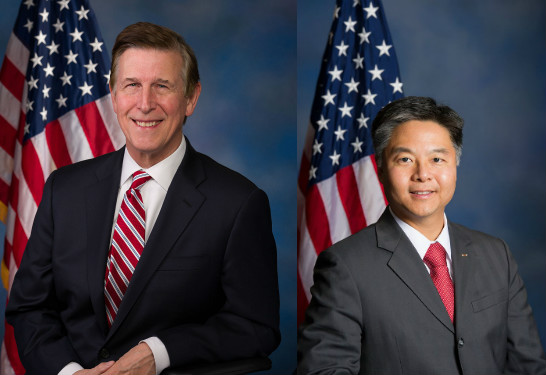
Representatives Don Beyer and Ted Lieu

Resource Guide For Federal Employees To Share Key Information With Public

Today, Congressman Ted W. Lieu (D | Los Angeles County) and Congressman Don Beyer (D | Virginia) released a resource guide for federal employees. The guide explains how to safely and responsibly share information, and encourages employees to “Know Your Rights” and “Know Your Options.” In the “Know Your Rights” section, federal employees can learn about which federal laws apply to them. In the “Know Your Options” section, employees can learn about how to safely disseminate information to agency inspectors general and the press. The resource guide also includes links to an in-depth list of federal whistleblower statutes and information about agency inspectors general.

Statement from Rep. Lieu:

“We believe the American people have a right to know how their government works. The Trump administration has strapped a muzzle on federal agencies and attacked legitimate whistleblowers. Should federal employees wish to break that silence, we want this to be a resource for the safe and responsible disclosure of information.”

Statement from Rep. Beyer:

“From day one the Trump Administration and its allies in Congress have treated the federal workforce like a punching bag, all while issuing hostile threats to whistleblowers and dissenters. In this age of gag orders and alternative facts, it’s important that we provide federal employees tools to ensure transparency. I look forward to working with Congressman Lieu in support of good government and federal workers.”

The resource guide can be found and downloaded at this link (PDF).

Coast Guard photo - Potomac River Oil Sheen

Coast Guard, Partner Agencies Respond to Potomac River Oil Sheen

This is an update to this post on this week’s Potomac River oil spill.

The Unified Command continues to respond to reports of oil sheens Friday in the Potomac River near Arlington, Virginia.

Containment boom and sorbent sweeps placed at an outfall in the vicinity of Roaches Run Waterfowl Sanctuary over night.

There have been no other potential discharges observed by any of the response personnel.

Tri-State Bird Rescue & Research has responded to reports of affected birds and are collecting the birds for cleaning.

Oil recovered by Coast Guard investigators has been sent to the Coast Guard Marine Safety Laboratory for analysis.

“The Unified Command has systematically responded to every National Response Center report in the National Capital Region we’ve received since Wednesday,” said Lt. David Ruhlig, the Unified Command operations section chief. “At this time it appears the sheen has largely dissipated and is limited to the area around Roaches Run, with minor wisps observed intermittently for five miles south. We’ll continue to maintain protective measures at the outfall and continue to monitor them, while also responding to any reports of oiled wildlife throughout the area.”

Coast Guard photo - Potomac River Oil Sheen

(Courtesy photos)

Dr. Gridlock on WashingtonPost.com has the list of street closings for Sunday’s Race For Hope event. If you’re driving into D.C. Sunday morning, take note…

The Race for Hope 5K walk/run is scheduled for 9 a.m. to about 11 a.m. Sunday in downtown Washington. The street closings are scheduled to begin at 5 a.m., and they should be reopened about 11 a.m. Metro opens at 7 a.m. Sunday. Federal Triangle and Metro Center are the closest stations to the start.

This is the route of the 5K: 12th Street and Pennsylvania Avenue NW (Freedom Plaza), south on Third Street NW, west on Independence Avenue SW, south on Fourth Street SW, east on E Street SW, north on Third Street SW, east on Maryland Avenue SW and north on First Street NW, west on Constitution Avenue NW onto Pennsylvania Avenue NW and back to 12th Street and Pennsylvania Avenue NW. See a course map (pdf).

These are the street closings:13th Street between E Street and Pennsylvania Avenue NW, Pennsylvania Avenue between 14th and Third streets NW, Third Street from Pennsylvania Avenue NW to E Street SW, E Street SW from Fourth to Third streets, Fourth Street from E Street to Independence Avenue SW, Independence Avenue from Fourth to Third streets SW, Maryland Avenue from Third Street SW to First Street NW, First Street to Constitution Avenue NW, Constitution Avenue from First Street to Pennsylvania Avenue NW.

Geodisc Water Fountain

Interesting Area News

Dr. Gridlock has a listing of the street closings in D.C. this weekend:

The International Monetary Fund and World Bank spring meetings are scheduled for this weekend in the District. Traffic congestion is likely to occur on the streets west of the White House. Street closings will start about 7:30 p.m. Friday and continue till about 5 p.m. Sunday.

These are the streets to be closed:

  • 18th Street NW from G Street to Pennsylvania Avenue NW
  • 19th Street NW from G Street to Pennsylvania Avenue NW
  • 20th Street NW from G Street to Pennsylvania Avenue NW
  • G Street from 18th to 20th streets NW
  • H Street (southern side) from 18th to 20th streets NW

Streets that lead to these closed streets may be restricted to local traffic only. Also, police can close other streets or alter the schedule at their discretion.

In addition to the streets closing, there might be a lot of these guys for the IMF spring meetings.

From NBC Washington:

If you plan on driving in D.C. Saturday, remember there will be street closures because of the National Marathon.

The race starts at 7 a.m. and begins and ends near RFK Stadium. It’s the only marathon run completely in the District.

Because it’s at the start and finish, 22nd Street NE will be closed from Independence Avenue to C Street from 2 a.m. until about 1:30 p.m.

Other streets will begin closing before 6 a.m. All streets are expected to be open by 1:30 p.m.

Metro is opening an hour early, at 6 a.m., to help people get to the marathon.

Click here to view the course and here for the complete list of street closures.


On June 24, Metro will determine if it will add a $.05 surcharge to your fare at certain stations in the Metro system. The first station to be affected will be Union Station. Will the surcharges come to the King Street or the Eisenhower Ave station near our Carlyle neighborhood? I would think not as Alexandria’s stations has some of the lowest ridership. Stay tuned…

ABC7 News reports:

The Metro Board’s Finance Committee voted Thursday to create a new 5-cent surcharge for Metrorail riders using certain stations.
The measure would have to be approved by the full Metro board, which is scheduled to meet on June 24.

The committee did not specify to which stations the surcharge would apply, other than the Union Station stop, which is Metro’s busiest. The surcharge would apply to any rider who enters or exits at one of the specified stations, at any time the station is open.

The surcharge would raise an extra $3,200 on an average weekday at Union Station.

Raymond Davis said he would walk the extra blocks to avoid the surcharge.

“Yeah, I would go to another station,” he said. “I’m going to do that.”

“I think I might avoid Union Station if it cost an extra nickel,” added Pat Roach.

But the two seem to be in the minority on that point.

“Five cents wouldn’t bother me,” said Dan Smith.

One rider said he loved the idea and Irene Villanueve summed it up this way: “Five cents is not a lot.”

Each jurisdiction, Virginia, Maryland, and the District would designate two stations for the surcharge. The money would be used for improvements at the designated stations.

“I think Metro needs whatever it can take right now,” said Katy Daily. “So I think it makes a big difference.”

Many details still have to be worked out, including how long the surcharges would remain in place.

Metro CFO Carol Kissal said the earliest the surcharge could be implemented is August, pending the full board’s quick approval.

DDOT official Steve Strauss says his agency came up with the idea, and using it at Union Station, in order to fund improvements, including streamlining the process for passengers traveling between Metro and commuter trains. Currently, passengers are funneled through a single escalator, creating bottlenecks at peak times.

Two weeks ago, Metro’s board approved its largest fare increase to date, totaling $109 million and including 20-cent peak-of-the-peak surcharge for rush-hour riders.

At least one board member acknowledges customers may feel nickel-and-dimed.

“I think it is another fare increase, and I think we’ll have to watch that one carefully to see how it impacts our users,” said Catherine Hudgins, chair of the Metro board’s finance committee.

I don’t think I would mind the surcharge as one rider stated above ‘Metro needs whatever it can take right now.’  What are your thoughts on this in the comments below or in our discussion forum.

Real Time Analytics